Introduction
As peptide research continues to attract attention, one increasingly searched topic is Retatrutide vs Semaglutide. Many people exploring peptide science want to understand how these compounds differ from a structural and research perspective.
While both compounds are discussed within peptide-related conversations, they are distinct in their design, research focus, and scientific context.
This article provides a neutral, research-focused comparison between Retatrutide and Semaglutide.
What Is Retatrutide?
Retatrutide is an investigational peptide currently being studied in research environments. It is part of a newer category of synthetic peptides designed to interact with multiple biological pathways.
Researchers study Retatrutide to better understand:
- receptor interactions
- molecular signalling
- pathway behaviour in controlled settings
As an investigational compound, Retatrutide is supplied for research purposes only.
What Is Semaglutide?
Semaglutide is a peptide-based compound that is widely recognised within scientific and medical discussions.
Unlike investigational research peptides, Semaglutide has been studied extensively in both clinical and scientific contexts. It is often referenced in broader discussions surrounding peptide science and receptor interaction research.
Retatrutide vs Semaglutide: Structural Differences
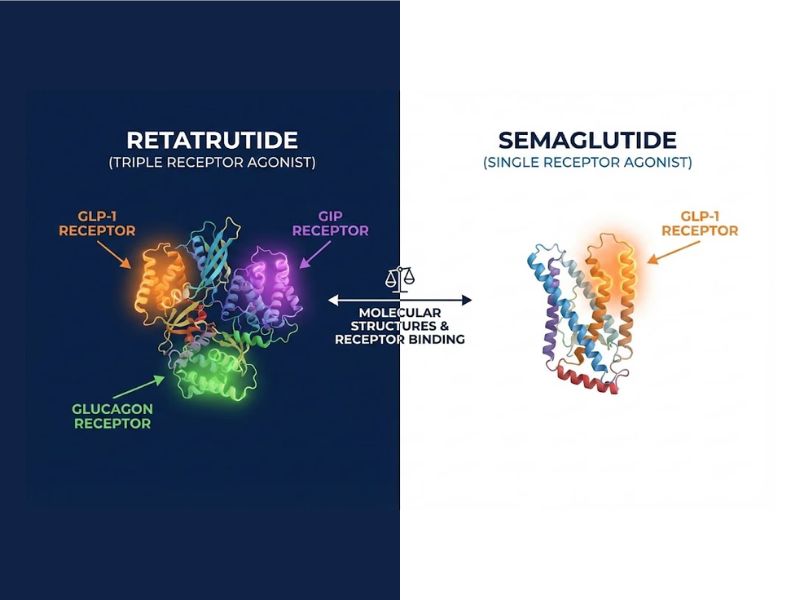
One of the main distinctions in the Retatrutide vs Semaglutide comparison is structural design.
Retatrutide is often discussed as a more complex investigational peptide due to its multi-pathway interaction profile. Its structure is designed to engage with multiple biological targets during research studies.
Semaglutide, by comparison, is commonly associated with a more focused receptor interaction model.
These structural differences are a major reason researchers analyse the compounds separately.
Research Focus and Scientific Interest
Another important distinction involves research focus. Retatrutide research often explores:
- multi-pathway interaction
- molecular complexity
- receptor signalling behaviour
Semaglutide discussions are generally more established due to the amount of existing scientific and clinical literature surrounding the compound.
Both continue to be referenced in peptide-related scientific discussions, but they occupy different positions within research contexts.
Why Are Retatrutide and Semaglutide Compared?
The comparison between Retatrutide and Semaglutide has become more common as interest in peptide science has expanded online.
Researchers and readers often compare compounds to better understand:
- structural differences
- pathway interaction models
- peptide design approaches
This helps provide context within the broader field of peptide research.
Understanding Investigational Peptides
Retatrutide belongs to the category of investigational peptides, meaning it is currently being explored within laboratory settings.
Investigational compounds:
- are still under scientific study
- are not approved for consumer use
- are researched under controlled conditions
Understanding this distinction is important when comparing different peptide compounds.
Important Information
Retatrutide is:
- an investigational peptide
- not approved for human consumption
- intended strictly for laboratory research purposes
All peptide discussions should remain educational and research-focused.
Conclusion
The discussion around Retatrutide vs Semaglutide highlights how peptide research continues to evolve. While both compounds are part of broader peptide-related conversations, they differ in structure, research focus, and scientific context.
Understanding these differences helps create a clearer picture of how investigational peptides are explored within modern research environments.